 blog
blog
Best Billiard Balls for Home Play: 2026 Buyer's Guide
Table of Contents
- What to Look for in Billiard Balls for Home Play
- Phenolic Resin vs Polyester Pool Balls
- Standard Ball Sizes and Weights for Home Tables
- How to Clean Billiard Balls: Step-by-Step
- Billiard Ball Maintenance Tips for Long-Lasting Performance
- Home vs Tournament Sets: What's the Difference?
- Conclusion
- Frequently Asked Questions
Last Updated: September 13, 2026
What to Look for in Billiard Balls for Home Play
Most home players buy a set of billiard balls based on looks, then wonder why the cue ball drifts or the finish dulls after a few months. At Sonny's Billiard Supplies & Home Entertainment, we see this constantly: the balls are the cheapest part of the setup and the one component that quietly decides how every shot feels. If you want the best billiard balls for home play, stop shopping by colour and start shopping by material, weight, diameter tolerance and finish. Below, we break down exactly what separates a set that lasts a decade from one that disappoints by Christmas.
A common mistake is assuming all sets are interchangeable. They are not. The differences are measurable, and they show up on the table within a week.
Key Specifications at a Glance
| Specification | What to Check | Why It Matters |
|---|---|---|
| Material | Phenolic resin vs polyester | Rebound, longevity, finish |
| Diameter | 57.15 mm (2 1/4 in) pool; 52.5 mm snooker | True roll, set consistency |
| Weight | 170 g pool; 142 g snooker (carom: 205-220 g) | Impact energy, cue ball control |
| Roundness | Tight diameter tolerance | Straight shots, no wobble |
| Finish | Polished, low friction coefficient | Cloth wear, spin response |
Phenolic Resin vs Polyester Pool Balls
Phenolic resin balls are the standard for serious play because they hold their shape, resist impact and keep a consistent rebound far longer than polyester. Polyester sets cost less and are perfectly fine for occasional games, but they scratch, dull and lose roundness faster under heavy use. The material choice is the single biggest factor in how a set performs over time.
How Material Affects Play and Longevity
Phenolic resin is a thermoset plastic: once cured, it stays hard and dimensionally stable. That translates into predictable rebound characteristics and a surface hardness that resists burn spots on the cloth. Polyester is softer, so it absorbs more impact energy, which mutes the cue ball's response and accelerates wear on both the balls and the felt.
If you play several times a week, phenolic is worth the extra outlay. If the table sees action twice a month, a quality polyester set will serve you well for years.
Why Cloth Type Changes the Equation
Most buying guides treat ball material as an isolated decision. It is not. The cloth on your table determines how much of the ball's surface finish and hardness you actually feel, and the pairing matters more at home than in a tournament hall where conditions are controlled.
Worsted cloth is the tight, fast surface found on most modern home tables and nearly all competition tables. Its combed, parallel fibres create low friction and a quick roll. On worsted cloth, a polished phenolic ball glides with very little drag, so spin transfers cleanly and the cue ball holds its line on thin cuts. A softer polyester ball on the same surface can feel skittish: it grips slightly more, which sounds harmless until you notice the cue ball checking up short on draw shots or drifting on slow rolls. The harder phenolic surface also resists the fine burn marks that worsted cloth is prone to showing under repeated break shots.
Woolen cloth is the napped, slower surface still common on older home tables and pub-style setups. Its raised fibres create more friction and a heavier roll. Here the trade-off flips. A polyester ball's softer surface and slightly higher friction coefficient can actually feel more predictable on woolen cloth, because the cloth is already doing most of the work of slowing the ball down. Phenolic balls on woolen cloth still play well, but the speed difference between the two materials becomes less noticeable, which is why some home players reasonably conclude that polyester is "good enough" on a slow table.
The practical rule: the faster and finer your cloth, the more a phenolic set earns its price. On a slow woolen surface, a mid-range polyester set will not embarrass you. On worsted cloth, the gap in feel is immediate and obvious.
Matching the Set to the Rest of Your Equipment
Ball material also interacts with cushion rubber and cue tip hardness. Hard phenolic balls transfer more energy into the cushions, so a table with tired or low-rebound rubber will expose that weakness faster. If your cushions are original to an older table, a softer polyester set can mask some of the loss of rebound. This is not a reason to buy polyester on a good table, but it is a reason not to assume that upgrading the balls alone will transform a tired setup.
Standard Ball Sizes and Weights for Home Tables
Regulation pool balls measure 57.15 mm in diameter and weigh 170 g each; snooker balls are 52.5 mm and 142 g; carom balls run 61-65 mm and 205-220 g depending on the discipline (wpapool.com). Buying the correct regulation size for your table is non-negotiable, because ball weight and diameter must match your cloth and cushion setup for a true roll.
Weight consistency across the set matters as much as the average. A set where one ball is a few grams heavy will visibly pull on thin cuts. Reputable manufacturers hold both weight and diameter tolerance to tight limits, and that precision is what you are paying for. For guidance on how balls interact with playing surfaces, the World Pool-Billiard Association equipment standards set out the recognised specifications.
How to Clean Billiard Balls: Step-by-Step
Cleaning billiard balls takes about five minutes and protects both the finish and your cloth. Use mild soap, lukewarm water and a soft microfiber cloth. Never use alcohol, acetone or abrasive cleaners: they strip the polish and leave the surface prone to static electricity and dirt pickup.
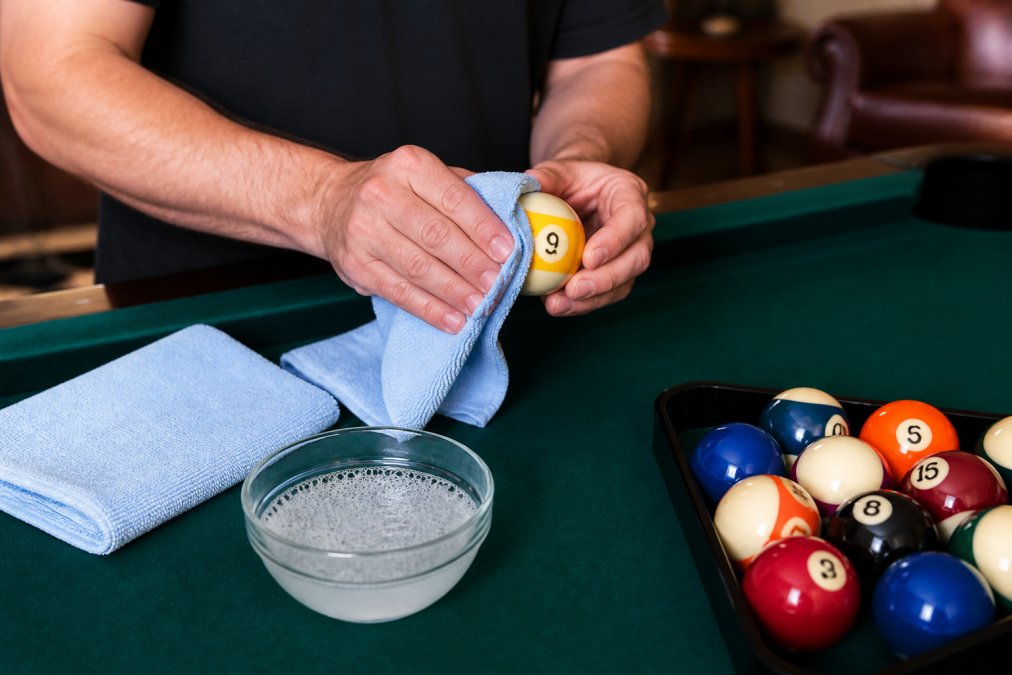
- Fill a bowl with lukewarm water and a drop of mild dish soap.
- Wipe each ball with a damp cloth, working around the full surface.
- Rinse with a clean damp cloth, no soap residue left behind.
- Dry immediately with a dry microfiber towel.
- Buff the cue ball last, since it picks up the most chalk.
Billiard Ball Maintenance Tips for Long-Lasting Performance
Billiard ball maintenance tips come down to three habits: clean after every session, store away from heat and sunlight, and rotate the set. Chalk dust is abrasive, and left on the balls it grinds into the finish and transfers to the cloth. A two-minute wipe-down after play prevents most of the wear you would otherwise see in a year.
How Home Room Conditions Affect Your Set
A home game room is a far harsher environment for billiard balls than most owners assume. Unlike a climate-controlled tournament hall, a garage, basement or spare bedroom swings in temperature and humidity through the year, and those swings act on the balls continuously.
Phenolic and polyester are both hygroscopic to a degree, meaning they can absorb and release small amounts of moisture from the air. Over many cycles, that movement stresses the resin matrix. The visible result is usually not a dramatic crack but a slow loss of roundness: a ball that once rolled true begins to drift a fraction on slow shots. In a room that regularly exceeds roughly 60 percent relative humidity, or that drops below freezing in winter, the effect accelerates (energy.gov).
Temperature matters separately. Sustained heat softens the surface slightly and makes it more prone to picking up chalk and grit, while UV from a window or a nearby lamp fades the colour and can make the resin more brittle over years. A ball left on a windowsill in summer is not just at risk of fading; it is being cycled through expansion and contraction that a ball stored in a stable cupboard never sees.
The practical fix is not expensive. Keep the set in a felt-lined tray or the original box, in the most temperature-stable room you have, away from radiators, windows and exterior walls. If your game room is a garage or basement, a simple lidded case with a silica gel pack will flatten the humidity swings considerably. Rotate the set so no single ball sits in the same position in the tray for months.
Reading Wear Patterns: When a Set Needs Replacing
Most owners replace a set when a ball visibly chips. By then the set has been playing badly for months. Learning to read the early signs lets you replace on your terms rather than after a frustrating session.
Burn marks are the first thing to look for. These are small, dull, slightly rough patches that appear where the cue ball repeatedly strikes the object ball, most often on the break. On phenolic balls they develop slowly and can often be polished out. On polyester they appear sooner and tend to deepen rather than polish away. Hold each ball under a bright light at a shallow angle; burn marks show as a loss of gloss in a small area.
Micro-cracks are the second sign. These are hairline fractures, usually near the poles or around the equator where impact stress concentrates. They are nearly invisible in normal light but show up when you roll a ball across a clean, flat surface and watch for a wobble or a change in direction. A ball with a micro-crack will not roll true, and no amount of cleaning will fix it.
Colour fade and surface dulling are the third sign. If a ball that was once glossy now looks matte even after cleaning, the polish has worn through to a rougher layer. That rougher surface picks up more chalk, transfers more grit to the cloth, and changes the friction characteristics you rely on for spin.
A simple annual check: clean the set, then roll each ball slowly across your table and watch the line. Any ball that deviates from a straight roll, or that sounds different when tapped against a known-good ball, is a candidate for replacement. Replacing a single ball is rarely satisfactory because weight and diameter matching across a set is what makes the set play consistently. In practice, one bad ball usually means the set is due.
Home vs Tournament Sets: What's the Difference?
Tournament-grade sets are held to tighter diameter tolerance, weight matching and surface polish than typical home sets, and they are calibrated for consistent rebound on standard cloth. Home sets are built for durability and value, and many are perfectly playable, but they rarely match tournament precision.
For a home table, a mid-tier phenolic set gives you most of the tournament feel without the tournament price. If you are furnishing a full game room, Sonny's Billiard Supplies & Home Entertainment stocks pool, carom and snooker sets alongside tables, cues and accessories, so you can match everything in one order.
Conclusion
Choosing the right set is less about brand loyalty and more about matching material, size and weight to how you actually play. Get those three right and the rest follows.
If you would rather not guess, Sonny's Billiard Supplies & Home Entertainment can guide you through phenolic versus polyester, correct regulation sizes for your table, and the accessories that keep the set playing well for years. Get started with Sonny's Billiard Supplies & Home Entertainment and build a game room that plays as good as it looks.
Frequently Asked Questions
What are the best billiard balls for home use?
For home play, look for phenolic resin billiard balls because they resist chipping and hold their polish longer than polyester. Choose a regulation-size set (57.15 mm for pool) with consistent weight and diameter tolerance. If you play on a smaller table, a slightly lighter set can work, but standard weight (around 170 g) is best for true roll. Sonny's Billiard Supplies & Home Entertainment offers sets suited to different home tables, so check their range for options that match your table size and playing style.
Do expensive pool balls make a difference?
Yes, but not in the way beginners expect. Higher-priced sets typically use phenolic resin, which gives better impact resistance, truer roll, and slower wear. Cheaper polyester balls can develop flat spots or cracks sooner, especially if you play often. For occasional home play, a mid-range phenolic set is a smart investment. If you only play a few times a year, a decent polyester set may be enough, but expect to replace it sooner.
What is the difference between phenolic resin and polyester billiard balls?
Phenolic resin balls are harder, denser, and more resistant to impact and wear. They keep their shape and polish longer, giving a more consistent true roll. Polyester balls are softer, cheaper, and more prone to scratches and burn spots. For home play, phenolic resin is the better long-term choice, especially if you play regularly. Polyester can be fine for casual games, but it will show signs of wear faster, particularly on the cue ball.
How often should you replace your billiard balls?
Replace billiard balls when you notice visible cracks, flat spots, or a dull, uneven surface that cleaning won't fix. For home play with phenolic resin balls, a set can last several years with proper care. Polyester sets may need replacing every one to two years if used often. Check the cue ball first, as it takes the most impact. If the cue ball rolls unevenly or has chips, it's time for a new set.